Head & Neck Cancer Support Network Trust Community News October 2026
2026 Election: We asked. They answered.
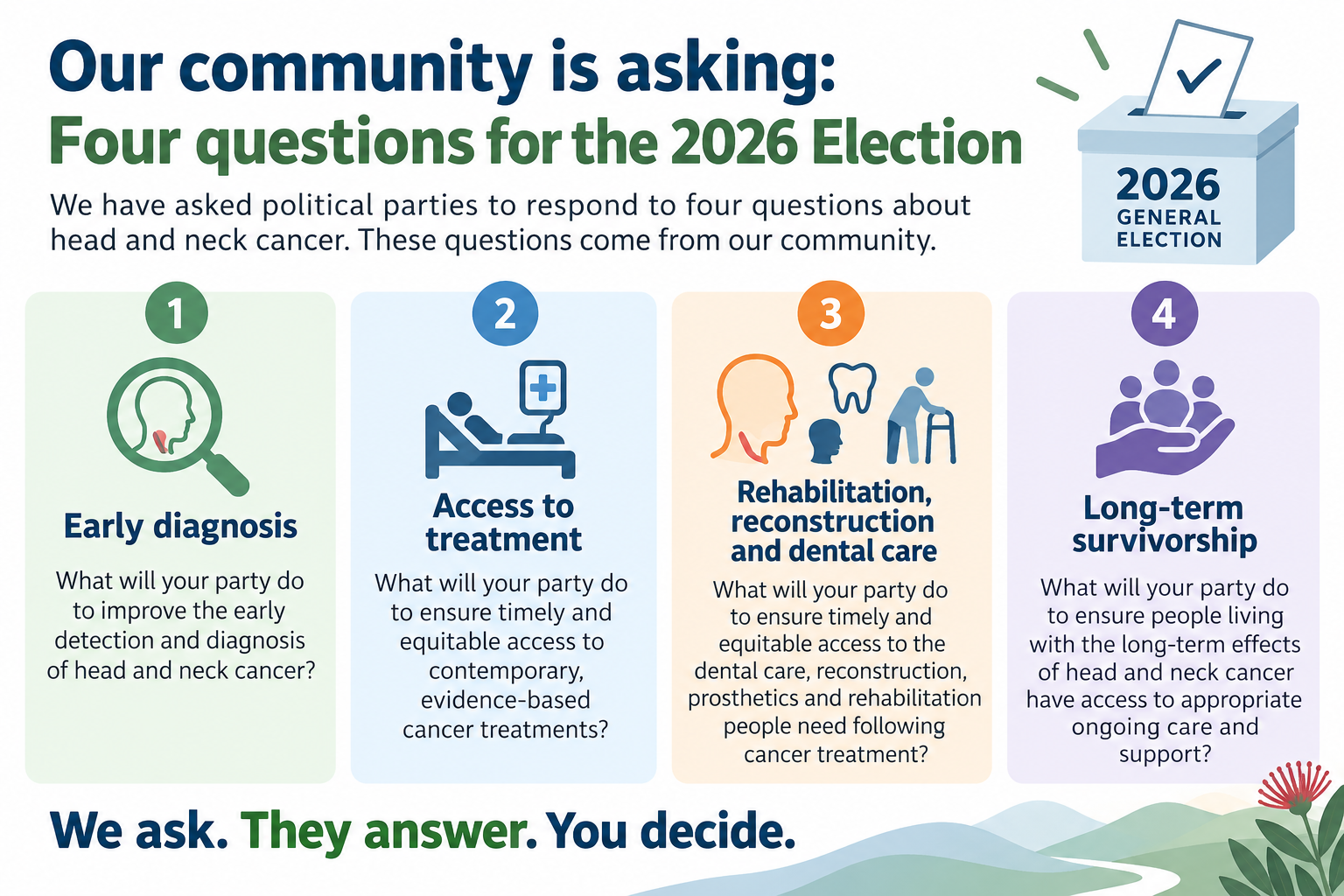
We want to make sure our community has the information it needs to make its own decisions.
As part of our election-year advocacy, we asked political parties four questions based on the concerns and priorities of people affected by head and neck cancer.
Our aim is simple: to make sure our community has the information it needs to make its own decisions.
We are pleased to have received our first response — from the Opportunity Party.
We are sharing their response with you in full and without comment.
Read the Opportunity Party's response to our four questions here:
https://www.headandneck.org.nz/election-2026
Our four questions focus on:
Early diagnosis
Access to contemporary cancer treatment
Rehabilitation, reconstruction and dental care
Long-term survivorship
We have asked the same questions of each political party and will publish the responses we receive on our website.
Why are we doing this?
The Head and Neck Cancer Support Network Trust is not endorsing or recommending any political party.
Our role is to make sure that the issues affecting people living with and beyond head and neck cancer are part of the election conversation.
We will publish the responses we receive so that you can read what the parties are saying and make your own informed decision.
We have asked each party to keep its response to a maximum of 150 words per question, so that the answers are concise and easier to compare.
As more responses arrive, we will add them to our election page.
We ask. They answer. You decide.
If you would like to read all the responses as they are received, visit:
What happened to the national work on complex head and neck cancer surgery?

ChatGPT generated image to preserve community members privacy and encourage engagement.
Health New Zealand confirmed that in 2022-23 national work on complex cancer surgery, including head and neck cancer, was undertaken. But almost three years after that work began, the national approach is still being developed.
We recently asked Health New Zealand, under the Official Information Act, what had happened to the national work on cancer surgical services and, specifically, what progress had been made for people with head and neck cancer.
This was an important question for us.
Our Trust was involved in the consultation and development of the national work. We therefore wanted to understand what had happened since the consultation, what had been implemented and where responsibility now sits.
The response gives us some useful information and it leaves some significant questions unanswered.
National work did take place
Health New Zealand has confirmed that engagement on this work began in 2022 and resulted in a national capability framework for complex surgery, including head and neck cancer.
Health NZ says this work was intended to inform the future provision of specialist head and neck cancer care.
The national work recognised that complex head and neck cancer surgery requires highly specialised surgical expertise and a range of supporting services. It also recognised the importance of multidisciplinary care, clear referral pathways and appropriate supportive care closer to where patients live.
These are important principles.
They reflect what people affected by head and neck cancer tell us about their experiences: treatment does not stop when surgery is over, and good care requires a coordinated pathway across surgery, reconstruction, dental care, speech and swallowing, rehabilitation and ongoing support.
The difficult question is: what happened next?
Health NZ told us that the national work has not resulted in a completed national head and neck cancer service model.
Instead, Health NZ is continuing to develop its broader Nationwide Clinical Service and Campus Plan. This work includes consideration of complex cancer surgery, including head and neck cancer.
Health NZ says its Nationwide Cancer Leadership Forum met with Te Aho o Te Kahu in August 2026 to discuss complex cancer surgery, including head and neck cancer.
The two organisations have agreed to continue working together on the approach to head and neck cancer within the wider planning work.
That is movement.
But it is not the same thing as implementation.
What does this mean for patients?
The national work identified the need for a more coordinated approach to complex surgery.
It envisaged specialist services working as a network, with the most complex surgery undertaken in appropriately resourced specialist centres and other parts of care provided closer to home where appropriate.
Health NZ has confirmed that this networked approach remains part of the direction of travel.
It says some specialist surgical services may ultimately be centralised to a smaller number of centres where this is necessary for safety, effectiveness and clinical sustainability. At the same time, the intention is to improve access to other services and provide clear referral pathways regardless of where care is delivered.
This is an important balance.
Centralising highly specialised surgery may be necessary. But centralising everything is not the same as creating a good national network.
For people with head and neck cancer, travelling to another centre for major surgery can have enormous consequences. Patients may already be dealing with lengthy treatment, loss of income, family responsibilities, accommodation costs and the physical and emotional effects of cancer.
If surgery is centralised, the rest of the pathway needs to work exceptionally well.
That means timely referral, good communication between hospitals, appropriate reconstruction and rehabilitation, and meaningful support close to home.
There is still work to do
Health NZ says that progressing complex surgery is now a key action in the Cancer Action Plan 2026–2029. Four - six years after the work began.
Health NZ is leading the work, with support from Te Aho o Te Kahu. The Planning and Funding Outcomes – Hospital Funding team is responsible for continuing development of the national clinical services and campus planning, including complex cancer surgery. Regional teams will be responsible for implementation.
This gives us a clearer understanding of where responsibility sits.
But it also creates some very reasonable questions.
What is the timetable?
Which services will be provided where?
What will happen to reconstruction and rehabilitation?
How will people living outside the major centres access specialist care?
How will Māori and other populations experiencing inequitable outcomes be affected?
How will Health NZ measure whether the new model is actually working?
And perhaps most importantly:
When will patients and whānau see a meaningful difference?
We will continue to ask
We do not want to give our community false hope.
There has been national planning work. There is agreement that complex surgery needs a more coordinated approach. The issue is now identified within the Cancer Action Plan.
But planning is not the same as delivery.
People living with head and neck cancer need more than another plan.
They need timely diagnosis and treatment. They need access to specialist surgery when it is required. They need reconstruction where appropriate. They need dental, speech, swallowing and other rehabilitation services. They need care coordinated across hospitals and regions. And they need support when they return home.
Most importantly, they need to know that where they live will not determine the quality or completeness of the care they receive.
We will continue to follow this work and ask Health NZ for evidence of progress.
We believe our community deserves to know not just what is planned, but what has actually changed.
We will keep asking the questions, because people affected by head and neck cancer deserve answers — and they deserve a health system that delivers on them.
-
21 October 8pm Auckland and Northland Support Group. Details to follow.
Invite link:
https://us06web.zoom.us/j/87518747006pwd=sKEUub8miDYMVoCHDD4lbwTbEu6IwE.1
Meeting ID: 875 1874 7006
Passcode: 438189
-
CanConnect - West Cancer Group meets on the second Thursday of each month 9.30 am to 11.30 pm at the Opanuku Studio, Corban Estate Arts Centre, 2 Mt Lebanon Lane, Henderson.
The meeting is for all those affected by cancer, patients and their supporters.
An engaging and supportive group who meet to learn and connect. Each month has a different wellbeing topic (with guest speakers). Following that, we connect over gentle movement and a cup of tea. If movement is hard for you, we have other great (non-walking) alternatives too. -
Dove House: Holistic Support for People Affected by Cancer
Dove Hospice & Wellness offers a wide range of supportive services for people living with cancer and other life-threatening illnesses, as well as for carers, families, and whānau. Based in Auckland, Dove House focuses on supporting emotional, physical, and spiritual wellbeing alongside medical treatment.
Services include nursing and medical support, counselling for individuals, couples, and families, physiotherapy, and a variety of holistic therapies such as oncology massage, Reiki, relaxation therapy, acupuncture, meditation, chair yoga, and lymphoedema management. These services are designed to help people manage the side effects of treatment, reduce stress, and improve quality of life.
Dove House also provides support groups for patients, carers, and people who are bereaved, creating opportunities for connection and shared understanding with others facing similar experiences. Workshops and education sessions are offered to help people build practical coping strategies and wellbeing skills during and after treatment.
For those unable to travel, Dove offers a mobile therapy service that brings supportive therapies into people’s homes. Dove Wing, the organisation’s inpatient unit, also provides respite and palliative care for people needing more intensive support.
Importantly, Dove Hospice & Wellness emphasises that hospice support is not only for end-of-life care. Their services are available to support people at many different stages of illness, including those undergoing treatment, recovering, or living with long-term conditions. The organisation’s approach is centred on helping people and their whānau feel supported, connected, and cared for throughout their journey. dovehospice.org.nz

A Message from the Chair
Kia ora koutou,
I want to begin by apologising for the absence of our September newsletter.
This winter has been a challenging one for me healthwise, and at times I simply haven't had the energy to keep everything moving as I would have liked. I know our newsletters are an important way of keeping our community connected, so thank you for your patience and understanding.
I am very much looking forward to summer — and to having a little more energy and space to get on with the work that matters to all of us.
Despite the challenges, we have continued working for you.
We continue to advocate for better services and better experiences for people affected by head and neck cancer. We continue to provide information, connection and practical support, and we continue to listen to what our community tells us is needed.
There is still much to do.
As a small charitable Trust, we rely on the generosity of our community and supporters to keep this work going. We are now looking ahead to 2027, and we need your help to ensure the Trust remains viable and able to continue its work.
If you are able to make a donation, no matter how small, it will help us continue providing support, advocating for change and making sure the voices of people affected by head and neck cancer are heard. https://www.headandneck.org.nz/donations
Thank you for standing with us, for your patience, your encouragement and your support.
I look forward to sharing more with you over the coming months — and hopefully to a brighter, warmer summer ahead.
With heartfelt thanks,
Ngā mihi,
Diana Ayling
Chair
Head and Neck Cancer Support Network Trust
Another way to join a Support Group

Want to do something different than Facebook?
We know Facebook isn’t for everyone — and sometimes you just want something simpler, more private, and easier to keep up with.
That’s why we’ve created a WhatsApp group for our community 💚
It’s a space for real-time connection, quick check-ins, and support when you need it most — without the noise of social media. Whether you prefer reading quietly or joining the conversation, you’re very welcome.
If you’ve been looking for a more personal way to stay connected, this might be the right fit for you.
-
https://www.headandneck.org.nz/donations
Thank you for your continued support.
-
If you are new to head and neck cancer, or back in treatment, we have a support pack for you. You can find all the details here. https://www.headandneck.org.nz/patient-planner
If you would like some brochures to introduce the Head and Neck Cancer Support Network Trust to your family and friends, please feel free to contact us headandnecknetwork@gmail.comThe New Zealand Cancer Society has a booklet Understanding Head and Neck Cancer you can access it here. Understanding Head and Neck Cancer
We have a toolkit designed specifically for those who stand beside us through the head and neck cancer journey. You can access it here https://www.headandneck.org.nz/light-keepers
-
Check out our latest articles. Curated articles related to the treatment, care and support of those affected by Head and Neck Cancer. https://www.headandneck.org.nz/advancements
-
We welcome contact from our head and neck cancer community, including whānau and friends. Please feel welcome at any of these contact points. https://www.headandneck.org.nz/contact-us